Electrician Harlow: what the work costs and how to hire safely
An independent guide to electrical work in Harlow and the CM17–CM20 postcodes. No sales pitch — what each job involves, what it typically costs, which jobs are notifiable by law, and how to check a contractor is on a competent person register before you let them near your consumer unit.
What electrical work costs in Harlow
These are indicative ranges for West Essex, not quotes. Prices move with access, the age of the existing installation and whether the work is notifiable. Treat anything far below the bottom of a range as a reason to ask what has been left out.
| Job | Typical 2026 range | Rough timeframe | Notifiable? |
|---|---|---|---|
| EICR (electrical condition report) | £79–£150 | 2–3 hours | No — it is an inspection |
| Consumer unit (fuse box) replacement | £450–£750 | Half a day | Yes — Part P |
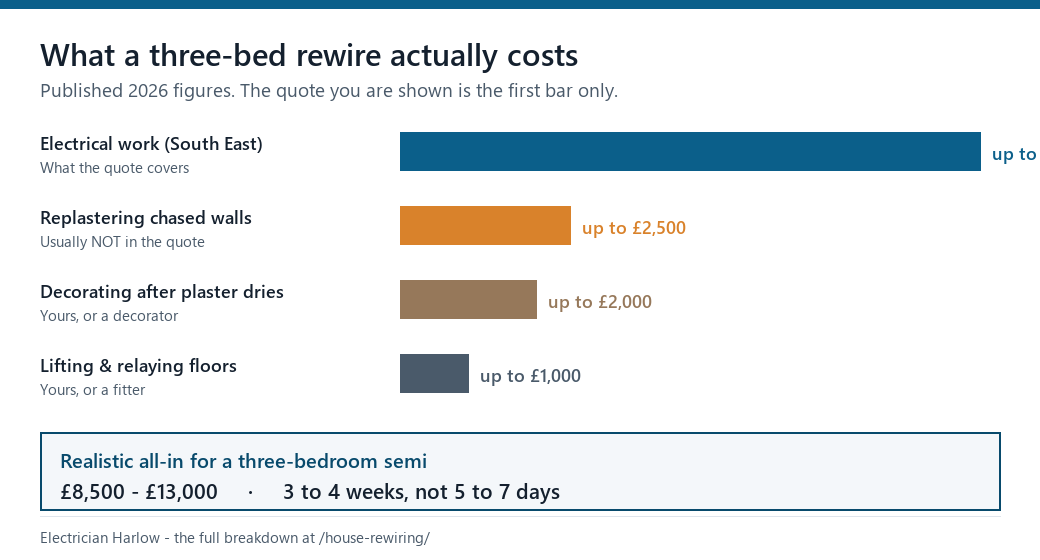
| Full rewire, three-bed house | £5,500–£8,500 +£800–£2,500 plastering | 5–7 days 3–4 weeks all-in | Yes — Part P |
| EV charger installation | £800–£1,500 less grant, if eligible | Half a day | Yes — new circuit |
| Power to a garage or outbuilding | £400–£2,500 | 1–2 days | Yes — new circuit |
| PAT testing | £1–£3 per item +£40–£80 minimum | Per visit | No |
| Extra socket or lighting point | £80–£150 per point | 1–2 hours | Depends on location |
| Fault finding / diagnostic visit | £100–£200 first hour | 1–3 hours | No |
Two of those rows are worth reading twice. The rewire figure is the electrician's price — replastering is usually not in the quote, which is the single biggest cause of budget shock on that job. And the PAT row is mostly a minimum fee: for a small office you are buying a visit, not the tests. Full breakdowns on house rewiring cost and PAT testing cost — and if you are letting the property, the certificate you are legally required to hold is covered on landlord electrical safety certificate, where the maximum penalty rose to £40,000 in May 2026.
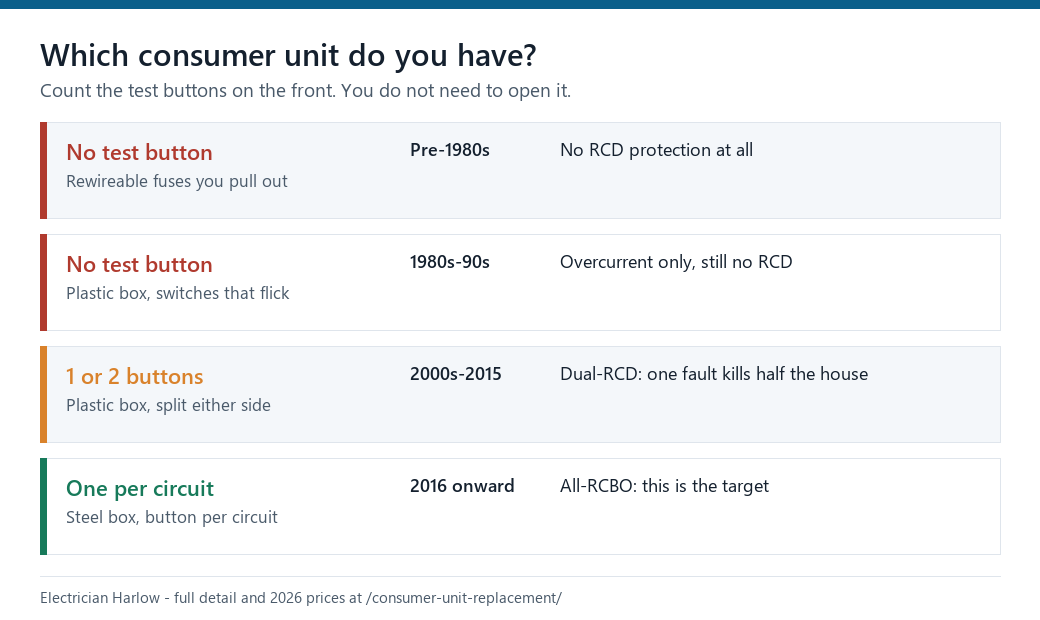
Which board have you got? Count the test buttons
You can place your own installation within about thirty seconds without opening anything. The number of test buttons on the front of the board tells you which generation you have, and that decides whether replacement is urgent, worth doing eventually, or unnecessary.
Which jobs you cannot legally do yourself
Part P of the Building Regulations covers fixed electrical installations in dwellings in England and Wales. Some work is notifiable — Building Control has to be told, and the work certified. Replacing a consumer unit, installing a new circuit (an EV charger, an electric shower, a garden supply) and most work in a bathroom zone all fall inside it. Replacing a like-for-like socket or light fitting on an existing circuit generally does not.
The practical consequence is about paperwork as much as safety. A registered electrician self-certifies and the certificate arrives with you. An unregistered one means you notify Building Control yourself, in advance, and pay for it — and if nobody did either, the missing certificate surfaces during a sale. See EICR testing and certificates for what the paperwork should look like.
Common Harlow jobs, and where to read more
- Emergency electrician in Harlow — what actually counts as an emergency, what a call-out costs out of hours, and what to isolate before anyone arrives.
- Electrical fault finding — tripping RCDs, dead sockets, lights that flicker under load, and why diagnosis is charged separately from the repair.
- EICR certificate cost — what the codes C1, C2, C3 and FI mean, why an FI can fail a report with no C1 or C2 on it, and what drives the price.
- Landlord electrical safety certificate — there is no document by that name in law, the penalty is now up to £40,000, and social landlords are in scope for the first time.
- Consumer unit replacement cost — 2026 prices, and the dual-RCD versus all-RCBO decision that nobody explains but that decides whether one fault takes out half the house.
- House rewiring cost — the all-in figure including the plastering that is never in the quote, and an honest test for whether you need a full rewire at all.
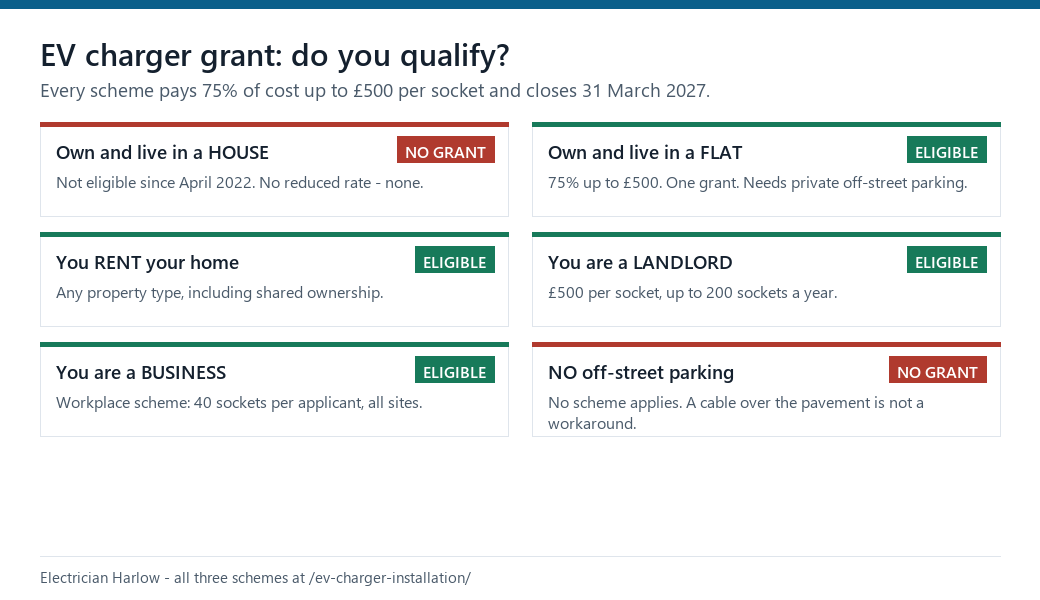
- EV charger grant — all three schemes at 75% up to £500, and the blunt answer for owner-occupiers of houses, who get nothing.
- PAT testing cost — and the HSE's own position that annual PAT is not a legal requirement, nor are labels or records.
- Garage and outdoor electrics — what a supply to an outbuilding costs, and why the burial depth everyone quotes is not actually in the standard.
- Lighting installation — downlights, outdoor and security lighting, and the loft-insulation clearance issue that catches most retrofits.
- Commercial electrical work — where inspection intervals are set by the installation and its use rather than a flat five years.
EV charger grants: most people get nothing
Every current government chargepoint grant pays 75% of cost up to £500 per socket and closes on 31 March 2027. The part installer websites bury is who is excluded — and if you own and live in a house, that is you.
Before you hire anyone
Do one thing first: search the contractor on the Registered Competent Person Electrical register. One search covers NICEIC, NAPIT, ELECSA and STROMA, it takes about thirty seconds, and it is the check almost nobody does — here is how, and what registration does and does not mean. It matters on this domain in particular: the website that stood here before this one claimed to be "NICEIC Approved" while trading under the name of a real, unrelated electrical company that is registered with NAPIT. One search disproved it.
Then read the guides rather than the sales pages. Do I need to rewire my house? answers no for most people. Fuse box or consumer unit? tells you which of four generations of board you have in thirty seconds, and when to leave a working one alone. RCD keeps tripping walks the elimination test that finds the circuit yourself. How long does a rewire take covers the week of plaster drying nobody schedules, and the EV grant if you rent or own a flat covers the group the grant was actually designed for. All of them are indexed at guides and advice, with cross-cutting questions on the FAQ page.
The area this site covers
Harlow itself (CM17, CM18, CM19, CM20) and the surrounding West Essex and East Hertfordshire belt — Sawbridgeworth, Old Harlow, Church Langley, Potter Street, Roydon and across toward Epping and Bishop's Stortford. Harlow's housing stock skews heavily to post-war new-town builds, which matters more than it sounds: a lot of the original installations have been part-rewired once already, so consumer unit work here frequently turns up mixed cable ages and missing earthing at the point of the survey rather than at the quote.
Get quotes from registered Harlow electricians
Tell us what the job is. We pass it to registered electricians covering CM17-CM20 and they come back to you directly.
What we will not do: we do not sell your details on, we do not add you to a marketing list, and we do not require a phone number. If you would rather not be called, leave the phone out — email is enough.
Questions people ask
How much does an electrician cost in Harlow?
Harlow prices to the published South East band — about £55–£75 an hour — rather than the £45–£65 UK average, because the town sits inside the London commuter belt and local labour can take London work. Domestic day rates are commonly £250–£300. But most jobs are priced per job rather than hourly, and on a short visit you are buying a minimum charge, not an hour: see electrician hourly rates for why comparing rates between quotes is close to meaningless, and what to compare instead.
Do I need a registered electrician to change a consumer unit?
Yes. It is notifiable under Part P. A registered electrician self-certifies and notifies Building Control for you; otherwise you must notify them yourself before work starts.
How often does a rented property need an EICR?
At least every five years. The 2020 Regulations came into force on 1 June 2020, applied to new tenancies from 1 July 2020 and to all existing tenancies from 1 April 2021. The landlord must supply the tenant with a copy, and complete any required remedial work within 28 days.